The Cage
of Autonomy
自主性的
牢笼
Eight core constraints — none elected, all constructed or discovered — set the ceiling on what Brazilian democracy can actually do. Five are cages: organized social power that no government will confront. Three are gyroscopes: institutions or rent systems the state built, delegated, or discovered. Beyond the cages lie two structural contexts — race and federalism — that underpin and reproduce all the others. And one figure who defined what maximum welfare extraction from inside the cage looks like. 八个核心约束——没有一个是选举产生的,全部是人为建构或被国家发现的——共同设定了巴西民主实际能做之事的天花板。五个是笼子:任何政府都不愿正面对抗的有组织社会权力。三个是陀螺仪:国家建立、委托或发现的制度与租金系统。笼子之外是两个结构性背景——种族与联邦主义——它们支撑并再生产着所有其他约束。还有一个人物,定义了在笼子内部提取最大福利的样子。
Brazilian democracy is real. Its constraints are also real. 巴西的民主是真实的。它的约束也是真实的。
Brazil is not an illiberal democracy in the conventional sense. Elections are free, courts function, the press publishes, and power transfers peacefully. The constraints operate one level below the electoral surface: in institutional design inherited from the military regime, in fiscal architecture that subordinates elected governments to financial markets, in land distribution patterns that predate the republic, in media ownership structures built by generals and protected by the constitution they wrote, in a congressional system that makes every president a hostage of patronage networks. 巴西不是传统意义上的非自由民主国家。选举是自由的,法院在运作,新闻自由出版,权力和平交接。约束在选举表面之下运作:在军事政权遗留的制度设计中,在使民选政府从属于金融市场的财政架构中,在早于共和国的土地分配模式中,在由将军们建造并被他们起草的宪法保护的媒体所有权结构中,在使每位总统都成为庇护网络人质的国会制度中。
The constraints operate in two distinct registers. Five cages represent organized social power: military privilege, land concentration, congressional patronage, media ownership, evangelical political infrastructure. Each has identifiable beneficiaries who actively defend it. Three gyroscopes — the central bank, the supreme court, and pre-sal oil rent governance — operate differently: they are institutions or rent systems the state built, delegated, or discovered, with no single fixed social owner, but with the power to override any elected government. Together, all eight set the effective ceiling on what Brazilian democracy can actually do. 这些约束在两个截然不同的层次上运作。五个笼子代表有组织的社会权力:军事特权、土地集中、国会庇护、媒体所有权、福音派政治基础设施。每一个都有能积极捍卫自身利益的可识别受益者。三个陀螺仪——中央银行、最高法院与盐下层石油租金治理——运作方式不同:它们是国家建立、委托或发现的制度与租金系统,没有单一固定的社会所有者,但拥有压过任何民选政府的权力。合在一起,全部八个设定了巴西民主实际能做之事的有效天花板。
Origin起源
Structural design locked in at regime transition (1964–1988). The military wrote the rules before leaving. The constitution codified existing power. 结构性设计在政权过渡期(1964–1988)被锁定。军方在离开前制定了规则。宪法将现有权力编纂成法。
Mechanism机制
Each government inherits the architecture and finds accommodation cheaper than confrontation. The cost of breaking any cage exceeds the political capital of any single term. 每届政府继承这一架构,并发现适应比对抗更便宜。打破任何一个笼子的成本超过任何一个任期的政治资本。
Result结果
Democracy operates inside the cages, not against them. The cages are the operating system; elections choose the user, not the software. 民主在笼子内部运作,而非与之对抗。笼子是操作系统;选举选择的是用户,而非软件。
Five cages. Three gyroscopes. One answer to the same question. 五个笼子。三个陀螺仪。同一个问题,同一个答案。
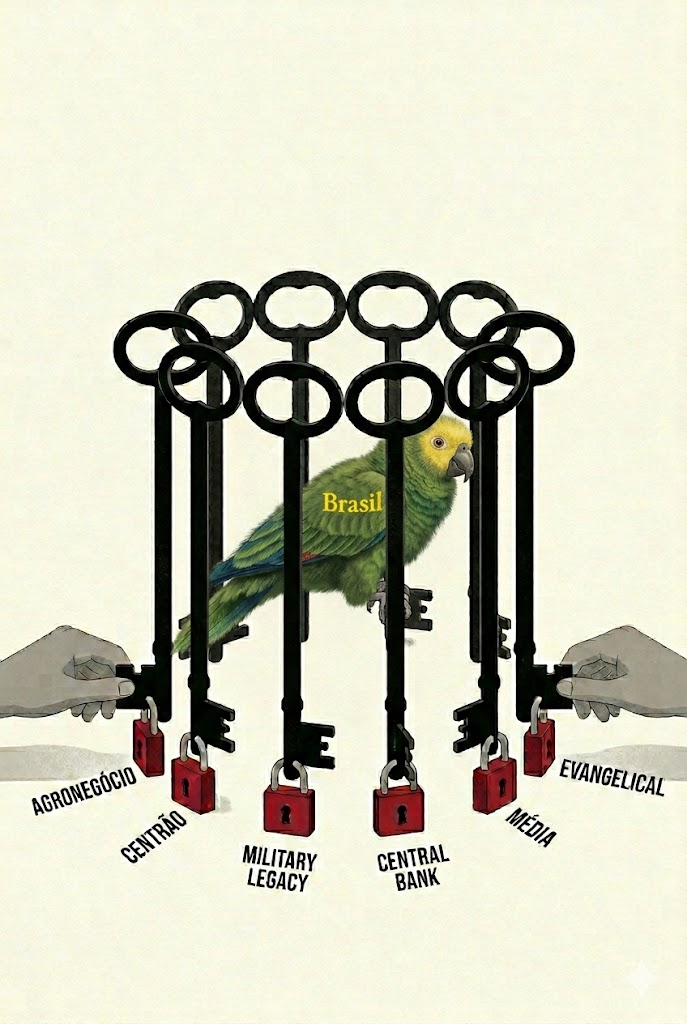
Five cage keys. Two gyroscope keys. One bird. — Cover illustration 五把笼子钥匙。两把陀螺仪钥匙。一只鸟。— 封面插图
Built, not evolved建造的,非自然演化的
All five cages and three gyroscopes emerged from deliberate institutional construction or rent discovery — military transition deals, constitutional drafting, licensing regimes, colonial land grants, delegated sovereignty, and the pre-sal oil shock — not organic development. 五个笼子与三个陀螺仪全部源于刻意的制度建构或租金发现——军事过渡交易、宪法起草、许可制度、殖民地土地授予、委托主权以及盐下层石油冲击——而非有机发展。
The casting of the cage牢笼如何被铸造
The origin plate turns the historical background into a sequence of institutional rivets: coup, amnesty, constitution, licenses, caucuses, platforms, and autonomy law. It shows how constructed power becomes inherited constraint. 起源证据板把历史背景转化为一串制度铆钉:政变、特赦、宪法、许可证、议员团、平台与自治法。它展示被建构的权力如何变成被继承的约束。
Inhabited, not dismantled居住其中,而非拆除
Every elected government since 1988 — Collor, Cardoso, Lula, Dilma, Temer, Bolsonaro, Lula III — has accommodated each cage rather than attempting structural reform. 1988年以来每届民选政府——科洛尔、卡多佐、卢拉、迪尔玛、特梅尔、博索纳罗、卢拉三期——都是适应每个笼子,而非尝试结构性改革。
Self-reinforcing自我强化的
Each cage’s beneficiaries control the mechanism that would reform it. The Bancada Ruralista blocks land reform. The military blocks accountability. The Centrão blocks electoral reform. 每个笼子的受益者控制着改革它的机制。农业议员团阻止土地改革。军方阻止问责。中间派阻止选举改革。
Three gyroscopes三个陀螺仪
BCB and STF are a different kind of constraint: the state tying its own hands. No fixed beneficiary. No class interest to defend. But both can override any elected government — and neither can be voted out. BCB和STF是另一种约束:国家捆绑自身之手。没有固定的受益者,没有需要捍卫的阶级利益。但两者都可以否决任何民选政府——且两者都无法被选举推翻。
The eight constraints八个约束
Five cages. Three gyroscopes. One answer to the same question. 五个笼子。三个陀螺仪。同一个问题的同一个答案。
Each assessment asks the same structural question: why didn’t the governments elected to change things change them? The answer is always the same: because accommodation was cheaper than confrontation, and the architecture made sure that remained true. Perry Anderson saw this in 2003 when the PT raised rates to 26.5%. It has been true for every government since. 每篇评估都在问同一个结构性问题:为什么那些被选来改变事物的政府没有改变它们?答案始终相同:因为适应比对抗更便宜,而架构确保了这一点始终成立。佩里·安德森在2003年PT将利率提高到26.5%时就看到了这一点。此后每届政府莫不如此。
The proof system is now organized as a three-step chain rather than a gallery of charts: Casting explains how constraints were made, Decision Terrain explains why accommodation becomes rational, and Reform Kill-Circuit shows where reform loses current. 现在的证据系统不再是一组图表陈列,而是一条三步证明链:铸造证据板解释约束如何被制造,决策地形解释为什么适应变得理性,改革阻断电路显示改革在哪些闸门失去电流。
The Casting of the Cage proof plate adds the historical layer: each constraint is treated as something cast, riveted, constitutionalized, and then inherited. “牢笼如何被铸造”证据板补上历史层:每个约束都被处理为某种被铸造、被铆定、被宪法化并被继承下来的东西。
The companion Auditable Decision Terrain visualizes the behavioral mechanism with explicit scoring logic: as executive vulnerability and confrontation costs rise together, accommodation becomes the rational basin into which otherwise reformist governments slide. 配套的可审计决策地形图用明确的评分逻辑展示其行为机制:当行政脆弱性与对抗成本共同上升时,适应就成为改革政府滑入的理性盆地。
1. Origin1. 起源
The Casting of the Cage turns history into institutional metallurgy: coup, amnesty, constitution, licenses, caucuses, platforms, and autonomy law become rivets. 牢笼如何被铸造把历史变成制度冶金:政变、特赦、宪法、许可证、议员团、平台与自治法变成铆钉。
2. Behavior2. 行为
Decision Terrain gives the behavioral mechanism: governments accommodate because vulnerability and confrontation costs rise together. 决策地形给出行为机制:政府选择适应,是因为脆弱性与对抗成本同时上升。
3. Failure Mode3. 失败机制
Reform Kill-Circuit makes the conclusion concrete: reform does not simply fail; it dies at named gates. 改革阻断电路把结论具体化:改革不是抽象失败,而是在具名闸门死亡。
| Cage笼子 | Mechanism机制 | Democracy Constrained被约束的民主维度 | Reform Blocked By改革被阻止的原因 |
|---|---|---|---|
| Military | Art. 142 + pension architecture + amnesty law 第142条 + 养老金架构 + 赦免法 | Sovereign 主权 | Transition deal + political cost 过渡交易 + 政治成本 |
| Agronegócio | Bancada Ruralista + Plano Safra + grilagem 农业议员团 + 农业计划 + 非法占地 | Territorial 领土 | Colonial land inheritance + FPA supermajority 殖民地土地继承 + FPA绝对多数 |
| Centrão | Open-list PR + emendas patronage system 开放名单比例代表制 + 拨款庇护制度 | Legislative 立法 | Electoral design (1988 constitution) 选举制度设计(1988年宪法) |
| Media | Seven families + military-era broadcast licenses 七大家族 + 军事时期广播许可证 | Informational 信息 | Art. 222 + Centrão protection 第222条 + 中间派保护 |
| Evangelical | IURD pipeline + bancada evangélica IURD管道 + 福音派议员团 | Cultural 文化 | Democratic legitimacy + institutional depth 民主合法性 + 制度深度 |
| BCB gyroscope | Inflation targeting + market discipline + CMN architecture — pulls toward financial orthodoxy regardless of governor 通胀目标制 + 市场纪律 + CMN架构——无论谁担任行长都拉向金融正统 | Economic 经济 | State self-constraint + capital market exit threat 国家的自我约束 + 资本市场退出威胁 |
| STF gyroscope | Constitutional interpretation monopoly + life tenure + self-referential jurisdiction 宪法解释垄断 + 终身任期 + 自我指涉的管辖权 | Judicial sovereignty 司法主权 | State self-constraint + constitutional design (1988) 国家自我约束 + 1988年宪法设计 |
Brazil’s democracy is real. Its constraints are also real. These are not contradictions — they are the same architecture seen from two angles. 巴西的民主是真实的。它的约束也是真实的。这些不是矛盾——它们是同一架构从两个角度看到的样子。
No single cage is fatal to democracy. The five cages together set the social ceiling — the limits imposed by organized interests that every elected government must accommodate. The three gyroscopes set the institutional and rent-governance ceiling — the limits the state has imposed on itself, delegated to unelected institutions, or discovered in oil rents that every coalition wants to control. Stacked together, these eight constraints explain why Brazilian democracy is real and its autonomy is not. That is the cage of autonomy. 没有任何单一笼子对民主是致命的。五个笼子共同设定了社会天花板——每届民选政府都必须顺应的有组织利益所施加的限制。三个陀螺仪设定了制度与租金治理天花板——国家施加于自身、委托给非民选机构,或在各方都想控制的石油租金中发现的限制。叠加在一起,这八个约束解释了为什么巴西民主是真实的,而其自主性却并不真实。这就是自主性的牢笼。
The cages have a fiscal expression. Three organized blocs — financial capital (6–8% of GDP in debt interest), the organized public sector (12% in pensions), and the federal bureaucracy (12.5% in civil wages) — have constitutionalized 30.5% of GDP as their pre-committed entitlement. Public investment receives 1.5%: the residual of a budget comprehensively captured before democracy can allocate it. → Fiscal Anatomy: Who Owns the State? 这些笼子有其财政表达。三个有组织集团——金融资本(公债利息6–8% GDP)、有组织公共部门(养老金12%)和联邦官僚机器(公务员薪资12.5%)——已将GDP的30.5%宪法化为其预承诺权利。公共投资仅剩1.5%:在民主政府能够分配预算之前,已被全面俘获的财政残余。→ 财政解剖:谁在占有这个政权?
Not a gallery: a proof chain. 不是图表画廊,而是一条证明链。
The core visual argument now has three primary plates. Everything else is an audit layer, a domain-specific evidence page, or a comparative appendix. 核心视觉论证现在由三张主图组成。其他页面退为审计层、专题证据页或比较附录。
The Casting of the Cage牢笼如何被铸造
Origin plate. Shows how constructed power becomes inherited constraint through institutional rivets: coup, amnesty, constitution, licenses, caucuses, platforms, and autonomy law. 起源图。展示被建构的权力如何通过制度铆钉——政变、特赦、宪法、许可证、议员团、平台与自治法——变成被继承的约束。
Auditable Decision Terrain可审计决策地形
Behavior plate. Uses explicit indices to show why accommodation becomes a rational basin when executive vulnerability and confrontation cost rise together. 行为图。用明确指数说明,当行政脆弱性与对抗成本共同上升时,适应为什么成为理性盆地。
Reform Kill-Circuit改革阻断电路
Failure-mode plate. Shows how land reform, media regulation, military accountability, and fiscal reallocation lose current at specific gates. 失败机制图。展示土地改革、媒体监管、军方问责与财政再分配如何在具体闸门失去电流。
Constraint Atlas约束总图
A compressed inventory map: five social cages, three institutional gyroscopes, two structural shadows, and the fiscal-financial floor beneath them. 一张压缩库存图:五个社会笼子、三个制度陀螺仪、两道结构阴影,以及其下方的财政—金融地板。
Territory as Policy Tool领土作为政策工具
A paired map-and-data plate showing how agrarian power works territorially while its strength is read through land concentration, caucus power, directed credit, and reform capacity. 一张地图与数据双联图,展示农业权力如何在领土上运作,并通过土地集中、议员团权力、定向信贷和改革能力来读取其强度。
Fiscal Anatomy财政解剖
Shows the fiscal expression of the cage: pre-committed claims, debt interest, pensions, public payroll, and the residual left for democratic allocation. 展示牢笼的财政表达:预承诺支出、公债利息、养老金、公务员薪资,以及留给民主分配的残余。
Brazil vs. U.S.: Institutional Power Split巴西 vs. 美国:制度权力分配
Two-panel comparison of decision-making power distribution across institutions, including military as a fifth institution for Brazil. 双面板比较各制度间的决策权力分配,包括军队作为巴西的第五个制度。
Race & Security Shadow种族与安全阴影
A structural context page: not another cage, but a shadow that underpins policing, territorial control, federal inequality, and the politics of order. 结构性背景页:它不是另一个笼子,而是支撑治安、领土控制、联邦不平等与秩序政治的阴影。
Federalism Shadow联邦主义阴影
A second structural context page: the geography that reproduces bargaining, subnational vetoes, and uneven state capacity. 第二个结构性背景页:再生产交易、地方否决权与不均衡国家能力的地理结构。
Sources & References 数据来源与参考文献
A consolidated record of the primary datasets, institutional sources, and principal reference works underlying the assessment series — organised by category and analytical theme. 本评估系列所依据的主要数据集、官方来源及核心参考文献的汇总记录,按类别和分析主题整理。
Appendix: Key Data Sources & Reference Works ↗附录:关键数据来源与参考文献 ↗
Official government data (BCB SGS, IBGE, TSE, SIAFI, TCU, CNV…) · International databases (IMF, FAO, Pew…) · Research organisations · Academic reference works by assessment theme. 官方政府数据(BCB SGS、IBGE、TSE、SIAFI、TCU、CNV……)· 国际数据库(IMF、FAO、皮尤……)· 研究机构 · 按评估主题分类的学术参考文献。
Real-time signal tracking 实时信号追踪
The assessment series maps structural constraints. The daily brief tracks how those constraints manifest in real-time news — scanning 20+ RSS feeds, 25 key opinion leaders on X/Twitter, and 3 Reddit communities against the analytical framework. Updated daily at 07:00 BRT. 本评估系列绘制结构性约束。每日简报追踪这些约束如何在实时新闻中显现——扫描20+条RSS源、X/Twitter上25位关键意见领袖和3个Reddit社区,对照分析框架进行分析。每日北京时间07:00更新。
Brazil Daily Brief ↗ 巴西每日简报 ↗
Perry Anderson-style footnote · Top stories ranked by importance · Framework signals (supporting / challenging) · Divergence radar · Notable silences 佩里·安德森风格脚注 · 按重要性排名的头条新闻 · 框架信号(支持/挑战) · 分歧雷达 · 值得注意的沉默